
Springfield, MO · Garage Door Service
New Garage Door Installation for Willard Homes
Willard's garage doors date mostly to the 1996 build-out - original builder-grade steel, no insulation. Here's what a proper replacement looks like for this stock.
- Repairs & new doors
- Springs & openers
- Serving 6 nearby communities
How It Shows Up
The call we get from Willard almost always starts the same way: the door is original to the house, it's starting to sag at the bottom panel, and the opener strains before it catches the track. That's not a coincidence. Willard's housing stock centers on a median build year of 1996, a few years newer than the broader Springfield-area median of 1993, but still old enough that the garage door on most of these houses is pushing thirty years on original hardware.
What you're looking at is usually a single-layer steel door, builder-grade, installed when insulation in a garage door wasn't a standard spec and nobody thought twice about it. The panel itself may still look fine from the driveway. The problem is underneath - the roller tracks have widened with age, the torsion spring is rated for a door weight and cycle count from a different decade, and the opener running it was never built for today's duty cycle. When one of those finally lets go, it's rarely a quick fix. At that point you're not patching a 1996 door - you're replacing it with something built for how the house is actually used now.
What You Pay
We don't have a flat number to hand you here, and we're not going to make one up. What we can tell you is what tends to drive the cost conversation in Willard specifically. Median household income across the area runs $87,204, well above the $61,607 figure for the wider Springfield service area, and it shows in the calls: more Willard homeowners ask about upgrading to an insulated steel door outright rather than matching the original single-layer panel.
That's a real choice, not a sales pitch - an insulated door costs more up front than a like-for-like replacement of the builder door, and whether it's worth it depends on whether the garage is attached, whether there's living space above or beside it, and how long you plan to stay in the house. We'll walk the specifics with you on-site rather than quote blind over the phone, because the door that's right for a 1996 build in Willard isn't automatically the same door that's right for a house two streets over with a different layout.
What the Repair Takes
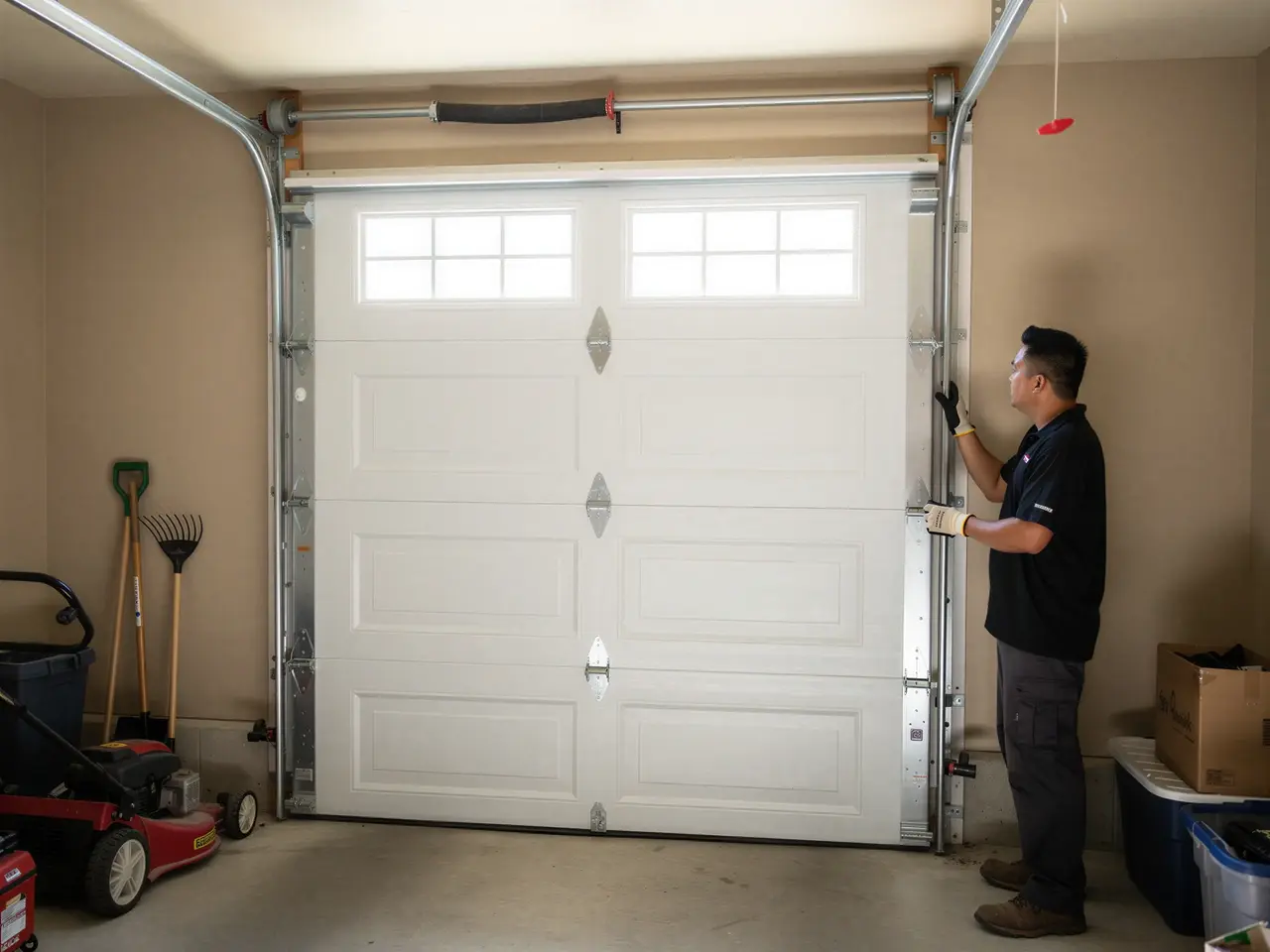
On a straight replacement, we're pulling the old door off its original track and spring setup entirely - track, torsion spring, and often the opener mounting bracket too, since thirty-year-old hardware rarely lines up cleanly with a new panel's weight and dimensions. The old springs in particular are sized for a door built to 1990s specs; they're not something you reuse on a new install even if they still look intact.
We set new track, new spring sized to the actual door you're installing, and reconnect or replace the opener depending on its condition. If the opener is original to the house, we'll tell you straight whether it's worth keeping - sometimes it is, sometimes the motor is already working harder than it should and replacing it alongside the door is the better call. We won't push a new opener on you if the one you have still has life in it. That's the honest limitation here: we're not going to swap parts that don't need swapping just to round out the job.
Time on the Job
A full door replacement isn't a quick in-and-out appointment, and we won't tell you it is. Pulling old track and spring hardware, setting new rail, hanging a new door, and getting the opener recalibrated takes real time on site - more if the opener or framing needs attention beyond the door itself. We plan the Willard visit as its own job rather than something squeezed between other stops, since it's a 10-mile drive out from Springfield and we'd rather do the work right than rush it to make a second call the same afternoon.
Weather plays a role too. This area sits in a cold-moderate climate band, and cold-weather installs mean the weatherstripping and bottom seal need to actually cure and seat properly rather than just get pressed into place and left. We'd rather take the extra time on that step than have you calling back in January about a draft.
Why This Fails Locally
Two things are working against the original doors in Willard at the same time: age and climate. The 1996 median build year means a large share of these doors are approaching the end of a normal service life for torsion hardware and steel panels, independent of any one bad winter or one rough slam of the door. On top of that, the area sits in a cold-moderate climate band, which means real temperature swings across the year - the kind of cycling that makes an uninsulated steel panel expand and contract, loosening seams and drying out weatherstripping faster than it would in a milder zone.
Put those two together and you get a specific failure pattern: doors that still close but no longer seal, openers straining against tracks that have shifted slightly out of true, and springs that are quietly past their rated cycle count. None of that shows up as a single dramatic failure most of the time - it shows up as a door that's gotten noisier, slower, and colder at the bottom edge over a couple of winters. That's usually the point where replacement makes more sense than another round of patching.
Parts We Carry
For a Willard install we're generally working with torsion springs sized to the new door's actual weight, not the original 1990s spec, plus new roller track to match. Where the homeowner wants it, we install insulated steel panels in place of the original single-layer door - a meaningful upgrade in a climate band that runs cold-moderate, since the insulated panel resists the expansion-and-contraction wear that ages out uninsulated steel faster.
We also carry weatherstripping and bottom seal kits suited to that same climate, since a seal that works fine in a milder zone can still dry and crack faster here. What we don't do is try to force a bargain door onto hardware built for a heavier or lighter panel - if the opener or track doesn't match the new door's spec, we'll say so and price the mismatch out rather than install something that'll be back on our call list in a year.
Frequently asked questions
Is my garage door original to the house if it hasn't been replaced?
Likely, if the house was built around the area's 1996 median construction year and nobody's mentioned a prior replacement. Original builder-grade doors from that era are typically single-layer steel with no insulation, and the torsion springs and track are sized to a build spec that's now roughly three decades old.
Do I need an insulated door if my garage isn't heated?
Not necessarily - it depends on whether the garage shares a wall with living space and how the door currently performs in winter. We'll look at your specific setup on-site rather than assume; it's not a decision we make the same way for every house in a cold-moderate climate band.
Can you reuse my current opener with a new door?
Sometimes. If the opener is in good working order and compatible with the new door's weight, there's no reason to replace it just because the door is new. We'll check the opener's condition during the visit and tell you honestly whether it's worth keeping or due for its own replacement.
Book garage door service in Springfield
Call now or request a quote - tell us what the door is doing and where you are.