
Springfield, MO · Garage Door Service
What We Actually Check on a Springfield Service Call
A look at what a Springfield Garage Door Pros service call actually checks, built around the 1962-2004 housing stock and cold-climate wear common across the area.
- Repairs & new doors
- Springs & openers
- Serving 6 nearby communities
The Situation
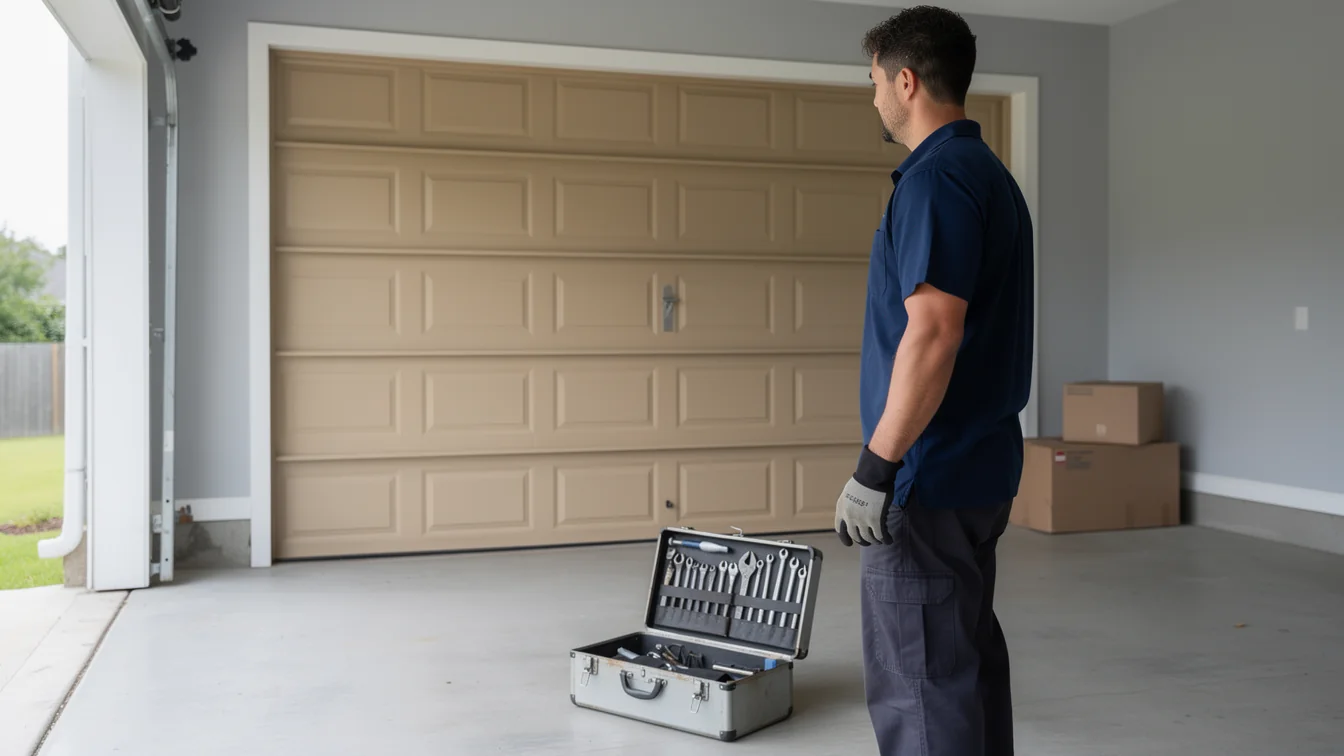
Most of the houses we get called to sit in neighborhoods built between 1962 and 2004, with the bulk going up through the 1980s and 90s across the thirteen areas we work - Fassnight, Westside, Southeast Springfield, Oak Grove, Doling, Bradford Park, Tom Watkins, Webster Park/Shady Dell, and the Northwest Springfield pocket among them. That matters because a door and opener installed in, say, 1991 is now over thirty years old, and the hardware that came standard then - chain-drive openers, single torsion springs rated for lighter doors, steel rollers - is past the point where it should be running on its original parts. A service call on a house from that era usually starts with us checking spring wind count and cable wear, because those are the parts that fail first on a system this old. On newer builds closer to 2004, the issues shift toward worn weatherseal and opener sensor alignment instead of outright spring failure. We look at the whole system, not just the symptom you called about, because on a door this age one worn part is rarely the only worn part.
Doing Nothing For Now
If the door still opens and closes and the noise hasn't gotten worse in the last few weeks, waiting is a reasonable call - not every noise is an emergency. But in a cold climate zone like ours, a spring or cable that's already stressed doesn't hold steady through a hard freeze; cold steel is less forgiving, and a marginal spring that was limping along in October can snap outright in January. We'd rather tell you that now than have you find it out at 6am with the car trapped inside. The honest limitation here: we can't tell you how long a worn part will last. We can tell you it's worn, and that in this climate band the failure tends to come on a cold morning rather than a mild afternoon. If you're planning to wait, ask us what we found and decide with that in hand, not without it.
The Common Mistake
The mistake we see most with houses from the 1962-2004 window is treating the opener as the problem when the spring or cable is what actually failed. A chain-drive opener from the 80s or 90s straining against a spring that's lost tension will sound like a dying opener - grinding, hesitating, running hot - right up until the spring snaps. Homeowners replace the opener, the door still won't lift right, and now they've spent money on the wrong part. On a service call we check spring tension and cable condition before we ever touch the opener itself, because on stock this age the spring is almost always carrying more years than it should. The second common mistake is waiting for total failure before calling, on the theory that a working door needs no inspection. A door that's merely loud or slow is already telling you which part is going.
What Local Conditions Do
Cold, moderate climate conditions here mean steel springs, cables, and hinges go through repeated contraction and expansion across the winter months, and that cycle is what shortens the working life of hardware that's already decades old on a lot of these houses. It's not one hard freeze that breaks a spring - it's a spring near the end of its rated cycles getting pushed over the edge by a cold snap. Garage temperatures in unheated bays swing more than people expect, and lubricant that was fine in August gums up or thins out by January, which is part of why winter is when we see the most broken-spring calls across the service area. None of this means the door needs replacing - most of these systems are sound. It means the wear items are the first thing worth checking before the weather turns, not after.
Frequently asked questions
How do I know if it's the spring or the opener?
If the opener runs but the door barely moves, or moves unevenly, it's almost always the spring or cable, not the opener motor. A healthy opener on a house this age should lift the door smoothly without straining. We check spring tension first on any call because on 1960s-2000s stock, that's the part carrying the most wear.
Is it worth fixing an old opener instead of replacing it?
Depends on what's actually broken. If it's a worn sensor or a frayed chain on an otherwise sound opener, repair makes sense. If the motor itself is the original unit from a 1980s or 90s install and it's failing outright, replacement usually costs about the same as a major repair and gets you a part with a real lifespan ahead of it.
Why do springs seem to fail more in winter?
Cold steel is more brittle and less forgiving than warm steel, so a spring that's near the end of its rated cycles is more likely to go in a cold stretch than a mild one. It's not the cold causing the failure on its own - it's cold conditions pushing an already-worn spring past its limit.
Do you serve areas outside Springfield proper?
Yes - our service area covers towns like Battlefield, Republic, Willard, Strafford, Rogersville, Clever, Fair Grove, Billings, Sparta, Highlandville, Ash Grove, Pleasant Hope, and Fordland, along with the Springfield neighborhoods themselves.
Related garage door services in Springfield
More garage door guides
Book garage door service in Springfield
Call now or request a quote - tell us what the door is doing and where you are.